The Facebook & Instagram app fills a Meta catalog with your products. Meta uses the catalog for Facebook Shop, Instagram Shopping and ads. Meta takes a feed for any market your store sells in.
The app also runs the Meta pixel on your storefront. It sends checkout steps and purchases from the server too, through the Conversions API. This way Meta can tie product views and purchases to the catalog.
The app installs on every plan. You set up the catalog in Feeds and the pixel on the app's own page.
Before you start
- A Meta business account with a catalog in Commerce Manager.
- Each country you want to sell or advertise in, added to one of your markets.
- For the pixel: your Pixel ID, the number Meta shows next to your pixel in Events Manager under Data sources.
- For the Conversions API: an access token, which you generate on your pixel's Settings tab in Events Manager.
Set up Facebook & Instagram
A feed gives you three addresses: the catalog address, a Language file with your product names and descriptions in your store's other languages, and a Country file with the prices and stock of the feed's market.
Open the App Store, find Facebook & Instagram and select Install. See App Store.
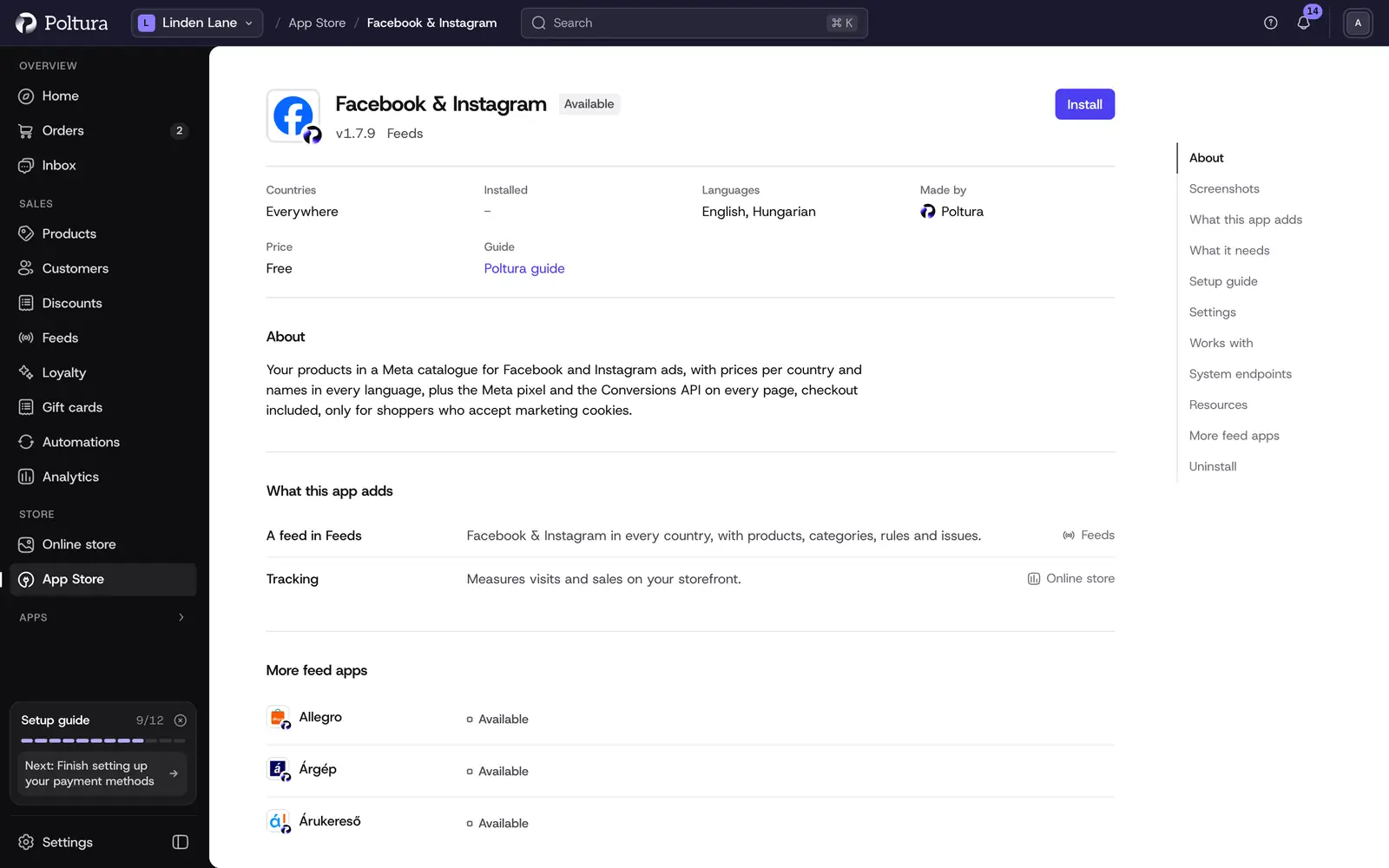
Facebook & Instagram in the App Store, before you install it. Open Feeds, select Add feed and choose Facebook & Instagram under Ready to set up.
On Market, choose the market the feed is for.
On What we send, check the list, then select Create the feed.
In Commerce Manager, open the Data sources of your catalog.
Add the catalog address as a scheduled data feed and choose an hourly schedule. Meta does not read a feed more often than that.
Under Country or language data, add the Language file as a language feed.
Under Country or language data, add the Country file as a country feed.
Back in Poltura, select I have pasted it.
Selling in more countries? Add a feed for each market and add each market's Country file to the same catalog. Add the catalog address and the language file only once per catalog: every market's feed lists the same product IDs, and Meta ignores a product whose ID appears twice.
The general steps of a feed are in Add and set up a feed.
Pixel and Conversions API
You find these on the app's page: open the App Store, then Facebook & Instagram, then Settings.
- Pixel ID: the number of your pixel, digits only, or the whole pixel base code from Events Manager: the field shows the ID it found, and only the ID is saved. The pixel stays off until it is set.
- Conversions API access token: lets Poltura send checkout steps and purchases from the server too, so an order still counts when an ad blocker stops the pixel. It is stored sealed and never reaches the storefront.
- Test event code: while it is set, server events go to Test events in Events Manager instead of your reports. Clear it when you are done checking.
- Customer data for better matching: when the shopper accepts marketing cookies, checkout events also carry their email, phone number, name and address as an irreversible code (SHA-256) (Advanced Matching). Mention it in your privacy policy.
- Conversion value: the order total, or the products only, without shipping.
- Send events from the server: on by default. Needs the access token. With marketing consent, server events carry the shopper's IP address and browser, which Meta asks for on every website event.
The pixel and the server send each event with the same event ID, so Meta keeps one copy of it.
To check the setup, open Settings, then Tracking, and use Test connection and Send a test event on the Facebook & Instagram card. For the test event, type the code Meta shows under Test events in Events Manager.
Feed settings
You find these on the feed's Settings tab.
A pixel you added yourself
Use this if your Meta pixel runs through Google Tag Manager instead.
- My Meta pixel runs through Google Tag Manager: tells Poltura that you manage the pixel yourself, so it can check it against the catalog.
- What my tag sends as the product: The product or The variant. Your store reports each product as
item_idand the chosen variant asitem_variant_id. The catalog lists variants, so your tag should senditem_variant_id.
What is sent
- Meta requires your shop price, so price rules do not apply to this feed.
- Meta uses Google's product categories. Matching them in Category mapping helps Meta place your ads, and no product is refused without one.
- A shipping cost is optional. Until the market has one, Meta shows your products without it.
What shoppers see on your storefront
The app adds no badge and no text. With a Pixel ID set, the pixel runs on every page of your storefront:
- on every page, as a page view;
- on product pages, as a product viewed;
- on a search, and when a product is added to the cart;
- when checkout starts and when payment details are added;
- after an order, as a purchase with its value, currency and the variant IDs the catalog lists.
The pixel runs on every page, checkout included, under a security policy that lets it reach only Meta's own services. Advanced Matching data reaches the pixel only on the thank-you page; the server events carry it for the checkout steps. See Tracking.
The pixel runs only for shoppers who accept marketing cookies, and so do the server events. See Cookie consent.
If something goes wrong
- Your pixel reports a different product ID than this catalogue. Your Google Tag Manager tag sends product IDs, but the catalog lists variants, so Meta cannot tie views and purchases to them. Send
item_variant_idin the tag, or add your Pixel ID on the app's page and turn your own pixel off. - Meta counts events twice. Both pixels run. Turn one of them off.
- The pixel does not fire. Check that the Pixel ID is set on the app's page and that the shopper accepted marketing cookies.
- Server events are not sent. Check the access token and that the shopper accepted marketing cookies. The event log under Tracking says why each event was sent, skipped or refused.
- Products are missing from the catalog. The catalog may read the catalog address of two markets, and Meta ignores a product whose ID appears twice. Keep one as the main feed and add the other markets only as country files.
- No brand, barcode or part number. Add at least one of them to the product.
- No JPEG or PNG photo. Upload the main photo as JPEG or PNG.
Other problems are covered in Feed issues.