The Microsoft Advertising app runs the UET tag on your storefront. It also sends checkout steps and purchases from the server, through Microsoft's Conversions API. This way Microsoft Advertising (Bing) counts your sales even when a browser blocks the tag. Both run only for shoppers who accept marketing cookies.
The app installs on every plan and works in every country.
Before you start
- A Microsoft Advertising account with a UET tag. You create one under Conversions, UET tag.
- The tag ID, which Microsoft Advertising shows next to your tag. It is digits only.
- For the Conversions API: the token of the tag. While editing the tag, pick Use Conversions API in the Set up tagging step, then Copy Token.
- For ID Sync: your customer ID (CID), the number after
cid=in the address bar while you are signed in to Microsoft Advertising.
Set up Microsoft Advertising
Open the App Store and open Microsoft Advertising. Select Install. See App Store.
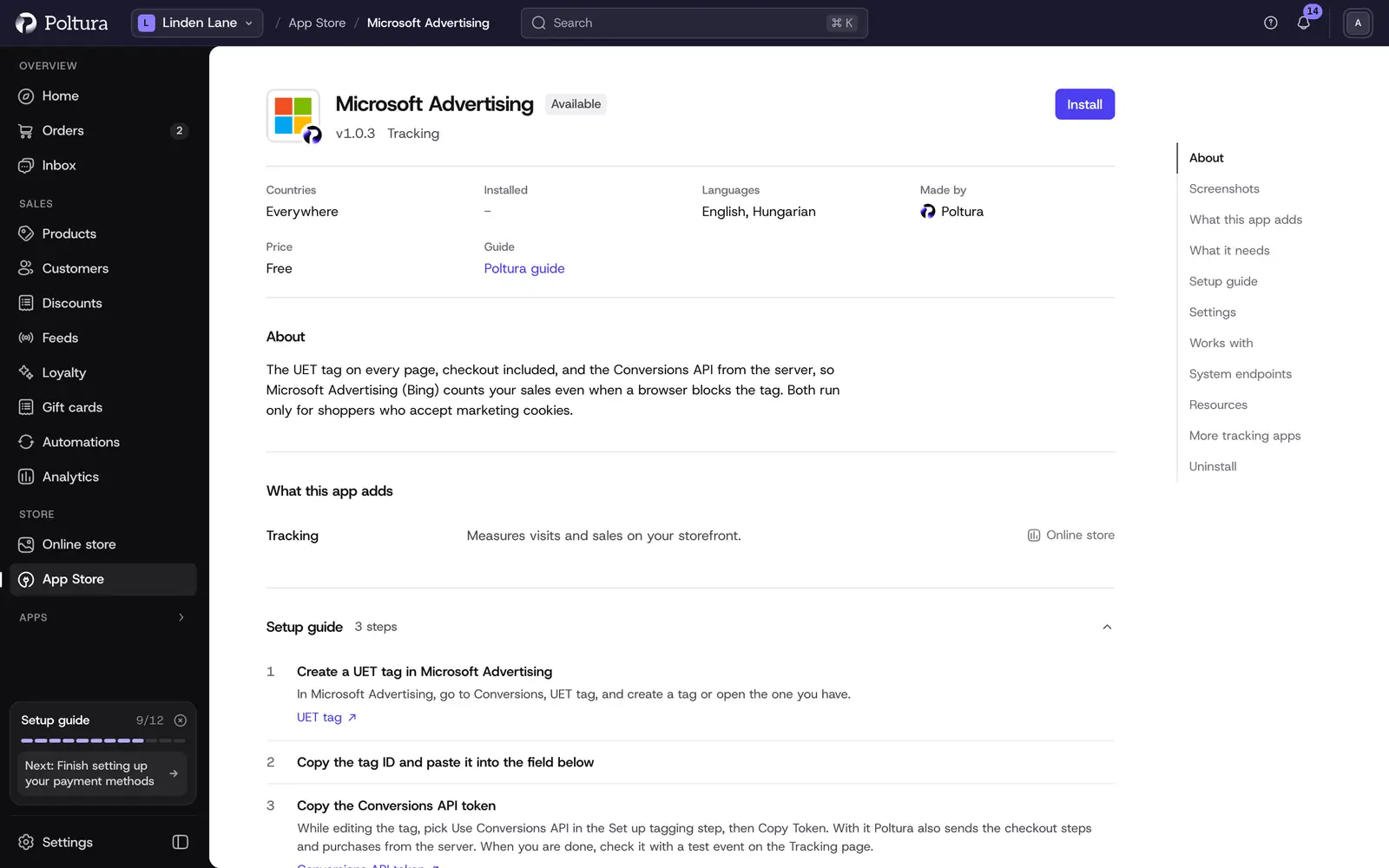
Microsoft Advertising in the App Store, before you install it. Under Settings, paste your tag ID into UET tag ID, or the whole UET tag code: the field finds the ID in it.
Paste the token into Conversions API token, and your customer ID into Customer ID (CID).
Select Save, and turn the app on if it is off. See App Store.
Check the connection on the Tracking page. See Check the setup.
Settings
- UET tag ID: the ID of your UET tag, or the tag code holding it. Only the ID is saved. The tag stays off until it is set.
- Customer ID (CID): with it the store ties the shopper's UET visitor ID to your account once a session (Microsoft's ID Sync), so server events match better and dynamic remarketing works.
- Conversions API token: lets Poltura send checkout steps and purchases from the server too, so an order still counts when an ad blocker stops the tag. It is stored sealed and never reaches the storefront.
- Customer data for better matching: when the shopper accepts marketing cookies, checkout events also carry their email, phone number and customer ID as an irreversible code (SHA-256), the email in Microsoft's own normalization (enhanced conversions). Mention it in your privacy policy.
- Conversion value: the order total, or the products only, without shipping.
- Send events from the server: on by default. Needs the token. With marketing consent, server events carry the shopper's Microsoft click ID (
msclkid), UET visitor ID, IP address and browser, so Microsoft can tie them to your ads.
The tag and the server send each event with the same event ID and action, so Microsoft keeps one copy of it. Every event also tells Microsoft the shopper's ad storage consent, as Consent Mode requires in the EEA, the UK and Switzerland.
What is sent
- Every page, as a page view.
- Product pages as
view_item, category pages asview_item_list, searches assearch, and products added to the cart or the wishlist asadd_to_cartandadd_to_wishlist. - Checkout start as
begin_checkout, payment details asadd_payment_info, and an order aspurchasewith its value, currency, order ID and products. - Sign-ups as
sign_up, and contact forms and newsletter sign-ups asgenerate_lead.
Products are named by their variant ID, the same ID your product feeds use, so dynamic remarketing finds them in Microsoft Merchant Center. Amounts are in the cart's or order's own currency. The server sends add_to_cart, begin_checkout, add_payment_info and purchase, up to 7 days after they happen. To count purchases, create a conversion goal of the Event type with the action purchase.
Checkout and the order pages
The tag runs on every page, checkout and account pages included, under a security policy that lets it reach only Microsoft's own services. Enhanced conversions data reaches the tag only on the thank-you page; the server events carry it for the checkout steps. See Tracking.
What shoppers see on your storefront
Nothing changes on the page. The tag loads only after the shopper accepts marketing cookies, and the cookie table lists Microsoft's cookies while a UET tag ID is set. See Cookie consent.
Check the setup
Open Settings, then Tracking, and use the buttons on the Microsoft Advertising card:
- Test connection checks that Microsoft accepts the token for the tag.
- Send a test event sends one
poltura_testevent with ad storage denied: Microsoft shows it among the tag's Conversions API events but uses it for no advertising, and no goal counts it.
If something goes wrong
- The tag does not fire. Check that the UET tag ID is set and the app is on, and that the shopper accepted marketing cookies. The UET Tag Helper browser extension shows each event and its consent (
asc). - Test connection says the token is not accepted. Copy the token again from the tag's Conversions API step. A token works only for the tag it was made for.
- Server events are not sent. Check the token and that the shopper accepted marketing cookies. An event without a click ID, UET visitor ID or (with the opt-in) hashed email has nothing Microsoft can match on and is skipped. The event log under Tracking says why each event was sent, skipped or refused.
- Microsoft counts events twice. A UET tag also runs from your Google Tag Manager container. Turn one of them off, or send the data layer's
event_idas the tag's event ID.